
Your Site Is Behind a CDN, So Why Is the Origin Still Overloaded? Building Origin Resilience, From Caching and Dynamic Requests to Failover
Published on 2026-11-14|By ByteShield Team
Key takeaways
- A CDN can take on content delivery through caching, but login authentication, order creation, and inventory updates usually still have to be handled by the backend.
- Origin Resilience comes down to three things: cutting unnecessary origin fetches, controlling the work that must reach the origin, and keeping services running with the ability to recover.
- Short cache times, parameters that do not change the content being included in the Cache Key, and purging the entire cache on every update can all send cacheable resources back to the origin again and again.
- Dynamic requests can be handled from three angles: transfer efficiency, legitimate load, and abnormal traffic. Retries also need limits so they do not amplify the load.
- Release processes and failure handling both belong in origin capacity planning, and a backup origin needs its capacity, data consistency, and backend dependencies checked.
The promotion goes live. Images load fine and the homepage opens without trouble, but users keep hitting delays and timeouts when they log in, check inventory, or check out. When the technical team investigates, they find the origin's CPU, database connections, and request queue are all still running high.
The site is already behind a CDN. So why can't the backend handle the traffic?
A CDN can take on content delivery through caching, so the origin does not have to send the same resources over and over. But operations like login authentication, order creation, and inventory updates usually still have to be handled by the backend. Whether the site stays stable depends on how many requests still have to go back to the origin, and whether the origin can handle them.
That is why, when evaluating a CDN architecture, speed and cache hit ratio are not enough. You also need to look at Origin Resilience: when traffic rises, the cache stops working, or parts of the system fail, can the architecture keep critical services running, and can it return to normal once the problem is resolved?
What Is Origin Resilience? From Reducing Load to Keeping Critical Services Running
Origin Resilience can be understood through three questions:
- Cutting unnecessary origin fetches: Is reusable content actually staying in the cache layer?
- Controlling the work that must reach the origin: Do dynamic requests, concurrency, and retries stay within what the backend can handle?
- Keeping services running and recovering: When capacity runs short or a component fails, are there degradation, failover, and recovery mechanisms in place?
These three need to be planned together. Even if images and downloads are already offloaded to the CDN, a search API that keeps running expensive queries can still overload the database. And even with a backup origin ready, if the primary and backup share a database that fails, transactions may still not complete after the switch.
The diagram below shows the work each layer can take on:
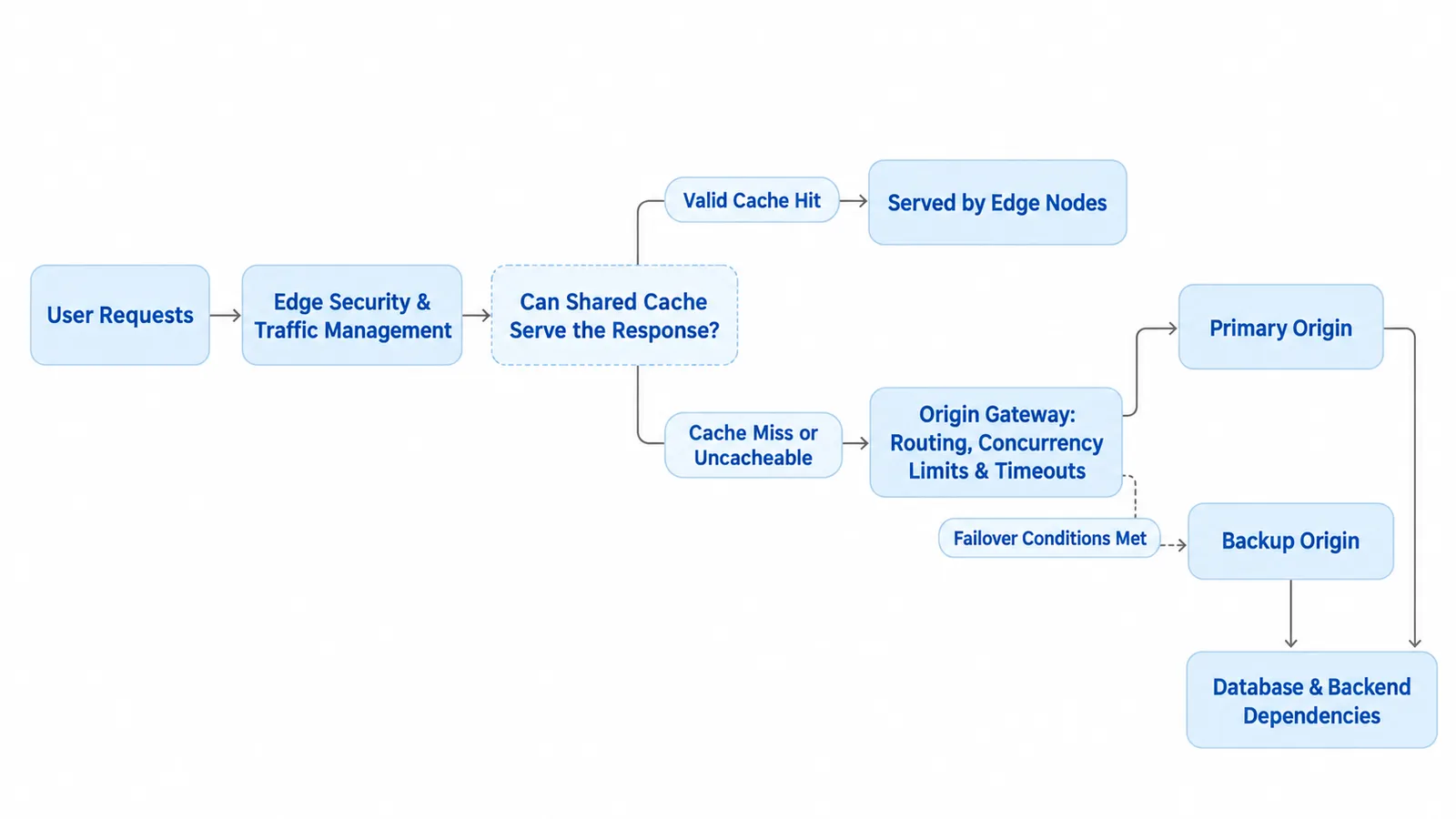
Architecture overview: the cache offloads reusable content, while the origin gateway and the application control how much work gets processed. Whether failover actually works still depends on capacity, data consistency, and backend dependencies.
Identify the Load First: Which Requests Actually Consume Origin Resources?
To improve Origin Resilience, you first need to know where the pressure comes from.
Site-wide averages easily hide local bottlenecks. Fast-loading images do not mean the checkout API can handle the same scale of use, and a high cache hit ratio does not mean the database still has headroom.
Start by breaking traffic down by content and business behavior:
| Request type | Typical content | What to watch first |
|---|---|---|
| Static assets | Images, CSS, JavaScript | Cache hits, version fragmentation, expiry and purge frequency |
| Public pages | Product pages, campaign pages, articles | Update frequency, personalization differences, shared caching conditions |
| Downloads and media | Installers, game update files, videos | Origin bandwidth, object size, early-release spikes |
| Dynamic APIs | Login, search, inventory, checkout | Request volume, concurrency, processing time, backend dependencies |
APIs also need to be judged by how they actually behave. Public, shareable query results can be considered for controlled caching, while content involving member identity, personal data, or transaction state needs a clear isolation and update strategy so responses are never shared by mistake.
When monitoring, look at origin request volume, transfer volume, and processing cost separately. A large update file might saturate egress bandwidth, while a handful of complex searches might exhaust database resources. The two call for different fixes.
Cut Unnecessary Origin Fetches: Keep the Cache Working at Peak
The value of caching is that the same content can be reused. Yet cacheable resources can still be fetched from the origin again and again because of how they are configured or released.
Common causes include cache times that are too short, parameters that do not change the content being included in the Cache Key, and purging the entire cache on every update.
When tuning, you can start here:
- Set cache times based on how often content changes and how much staleness is acceptable.
- Confirm which parameters, cookies, and headers actually change the response.
- Manage static assets with versioned URLs to narrow what needs to be purged.
- Check personalization and authentication conditions so cached content is never wrongly shared across users.
When many edge nodes miss at the same time, you can also check whether your platform supports tiered caching, Origin Shield, or request collapsing to reduce repeated origin fetches for the same content. These mechanisms mainly apply to cacheable content and cannot directly offload every dynamic transaction request.
The goal of cache optimization is to reduce the work the origin has to repeat, while keeping content correct and meeting update needs.
To check first whether your CDN cache is working as expected, see the troubleshooting steps in "Is Your CDN Actually Working?".
Control Necessary Origin Fetches: Keep Dynamic Requests Within Capacity
Login, search, and checkout are often the flows that most need protecting during peak periods. For these endpoints, you can split the problem into three areas: transfer efficiency, legitimate load, and abnormal traffic.
Transfer Efficiency: Where Is the Waiting Happening?
Cross-region connections, network quality, and connection setup can all add wait time to dynamic requests. Dynamic acceleration can optimize routing and connection efficiency, but you still need monitoring to tell whether the time is spent on network transfer, application processing, or database queries.
If the bottleneck is slow queries or backend computation, improving transfer will not be enough; the application and database still need tuning.
Legitimate Load: Normal Demand Can Exceed Capacity Too
Logins, lookups, and orders during a promotion may all come from real users. When demand exceeds capacity, you need to evaluate per-endpoint concurrency limits, connection pools, how fast you can scale, and queuing and degradation strategies.
For example, you can postpone non-real-time reports or temporarily refresh recommendations less often, saving resources for logins and transactions. Queues also need capacity and wait-time limits, so requests do not keep piling up and leave the system unable to recover after the peak has passed.
Retries need control as well. When requests slow down, simultaneous retries from the frontend, proxies, and backend services can amplify the original load. Review timeout settings, retry counts, backoff, and jitter. For operations like placing orders or payments, also consider idempotency to avoid duplicate execution.
Abnormal Traffic: Stop Limited Resources From Being Drained
Malicious scanning, automated logins, excessive scraping, and application-layer attacks can also concentrate on expensive endpoints.
Businesses can evaluate WAF, Bot Management, Rate Limiting, and DDoS protection strategies based on request characteristics, identity, and behavior. Rate-limiting conditions should fit the business context. Avoid judging by IP alone, which can also hit legitimate users on shared networks.
Design for Releases and Failures
A site that runs fine day to day can suddenly see a surge of origin fetches after a game update, a product launch, or a campaign asset release.
When a new version uses new file URLs, edge nodes have not stored that content yet. If the existing cache is purged at the same time, the first wave of users can trigger a concentrated burst of origin fetches. That is why the release process belongs in origin capacity planning too.
Before a release, confirm the update scope, purge method, and expected traffic, and depending on what your platform supports, consider phased releases or cache prewarming. Prewarming itself consumes origin resources, so control its pace and verify which regions and content it actually covers.
Failure handling needs to be defined in advance: When should you fail over? Which features can be temporarily degraded? Once the system recovers, how should traffic be gradually brought back?
Beyond passing health checks, a backup origin also needs these questions answered:
- Does it have the capacity to absorb the failover traffic?
- Do its data and login state meet business needs?
- Does it share a database, storage, or authentication service with the primary origin that could fail?
- Could switching over and switching back cause duplicate transactions or inconsistent data?
Origin Resilience has to cover "how to keep serving" and also "how to get back to normal."
How Do You Verify Origin Resilience?
When testing, use request mixes, data volumes, and traffic patterns close to your real business, and confirm that users can complete critical operations.
| Test scenario | What to confirm |
|---|---|
| Normal traffic | Baselines for origin volume, latency, and resource usage |
| Sudden traffic spike | Critical endpoint success rate, concurrency, and capacity headroom |
| Cold cache or version update | Origin spikes, bandwidth, and how fast the cache fills |
| Slower backend processing | Whether timeouts, retries, and queues amplify the load |
| Primary origin failure | Failure detection, backup capacity, and transaction correctness |
| Traffic drops or failure resolved | Whether queues drain and services recover |
Beyond average latency, look per endpoint at latency distribution such as p95, error rate, timeout rate, and whether logins, orders, and payments actually complete.
At the same business volume, the real measures of improvement are whether origin work goes down, whether critical operations stay stable, and whether the system recovers after a failure.
Build Origin Resilience That Fits Your Business, Starting From Your CDN Delivery Architecture
Planning for Origin Resilience can start from your current traffic and business flows: which content can be reused, which operations must be handled in real time, which endpoints cost the most, and which services must be kept running first.
Businesses can discuss CDN caching, origin traffic, dynamic delivery, and security protection needs with the ByteShield team, and combine that with their application team's knowledge of the code, database, and transaction flows to clarify what to improve at each layer and how to measure success.
To learn more about how a CDN distributes traffic at the edge and takes pressure off the backend, see "Using CDN as a Front-Line Load Balancer".
FAQ
My site is already behind a CDN. Why is the origin still overloaded?
A CDN can take on content delivery through caching, so the origin does not have to send the same resources over and over. But operations like login authentication, order creation, and inventory updates usually still have to be handled by the backend. Whether the site stays stable depends on how many requests still have to go back to the origin, and whether the origin can handle them.
What is Origin Resilience?
Origin Resilience is whether your architecture can keep critical services running when traffic rises, the cache stops working, or parts of the system fail, and whether it can return to normal once the problem is resolved. It comes down to three things: cutting unnecessary origin fetches, controlling the work that must reach the origin, and keeping services running with the ability to recover.
Why does cacheable content keep going back to the origin?
Common causes include cache times that are too short, parameters that do not change the content being included in the Cache Key, and purging the entire cache on every update. You can set cache times based on how often content changes, manage static assets with versioned URLs, and check whether your platform supports tiered caching, Origin Shield, or request collapsing.
Is having a backup origin enough to handle failures?
Not necessarily. Beyond passing health checks, you need to confirm that the backup origin has the capacity to absorb the failover traffic, that its data and login state meet business needs, whether it shares a database, storage, or authentication service with the primary origin that could fail, and whether switching over and back could cause duplicate transactions or inconsistent data.
If your site already runs on a CDN but the origin still gets overloaded during promotions, game updates, or traffic peaks, explore ByteShield's SCDN service, or contact the ByteShield team to assess how to improve your Origin Resilience, starting from your actual requests and architecture bottlenecks.