
From DNS Hijacking to Second-Level Scheduling: The Evolution of App Security Acceleration
Published on 2026-08-14|By ByteShield Team
Key takeaways
- Traditional app protection is limited by DNS dependency, a capacity arms race, and coarse protection granularity.
- A device-edge-cloud architecture extends security and scheduling to the client side.
- A security acceleration SDK reduces threats through four mechanisms: second-level switching, dynamic node assignment, trusted connections, and device risk detection.
- The core value: not just faster connections, but every connection identified, scheduled, and protected.
For an app with millions of daily active users, connection stability is the lifeline. When Local DNS fails or gets polluted, a traditional architecture that depends on DNS and CDN cannot react in time. Connections fail, APIs break, and in the worst case the fix has to wait days for an app store review and release.
DNS hijacking, pollution, and query attacks have always been major threats to mobile applications. When protection depends too heavily on DNS, the ability to respond in a crisis is severely limited.
Three limits of traditional app protection
1. DNS dependency limits scheduling speed and resolution security
- Hijacking and pollution risk: Local DNS results get tampered with and traffic is steered to the wrong nodes.
- Cache latency: TTL and caching mean node switches never take effect immediately.
- Discoverable entry points: Public resolution data makes nodes easy attack targets.
- Coarse scheduling: No way to schedule precisely per device or by real-time network speed.
2. Fighting with raw capacity turns into an expensive arms race
Traditional DDoS protection absorbs attacks with bandwidth and high-defense capacity. But capacity has limits, large attacks still cause latency or outages, and peak-based billing makes costs impossible to predict.
3. Coarse protection over-blocks and under-blocks CC attacks
Against low-frequency, distributed CC attacks that imitate real behavior, IP and request-rate thresholds misjudge easily. Mobile devices often share carrier IPs, so traditional rules can no longer identify real risk accurately.
From brute force to intelligent scheduling: the device-edge-cloud architecture
To solve these pain points, companies need to extend security and scheduling to the client side and build an integrated device-edge-cloud architecture:
- Device (SDK): Device environment detection, integrity checks, data encryption, and trusted access.
- Edge (converged edge platform): Intelligent scheduling, switching between acceleration and high-defense resource pools, traffic scrubbing, and connectivity to business servers.
- Cloud (platform and intelligence): Configuration management, operations analytics, link-quality monitoring, and attack localization and scheduling.
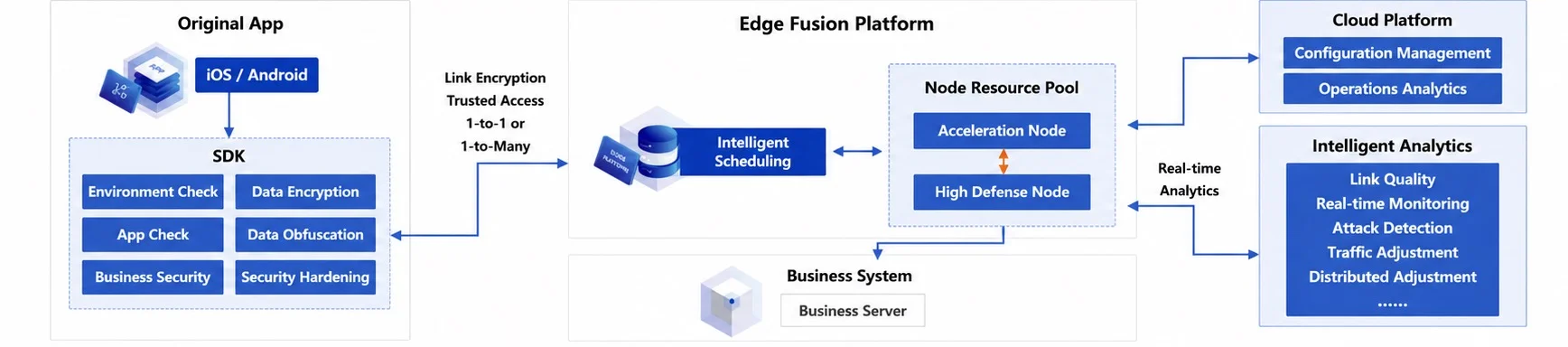
Four core mechanisms of a security acceleration SDK
Mechanism 1: Reduce Local DNS dependency for second-level switching
The SDK obtains available nodes through a protected control channel, bypassing Local DNS hijacking and cache latency, and refines scheduling down to the device level, with fallback mechanisms to prevent any single point of failure.
Mechanism 2: Assign nodes dynamically to shrink the attack surface
Entry points are assigned dynamically based on user location, network quality, and risk level, so attackers cannot lock onto a fixed target. When an attack occurs, abnormal traffic is steered to high-defense or isolation nodes.
Mechanism 3: Trusted connections and identity verification raise the bar for CC attacks
Per-device and per-connection keys, timestamps, and request signing block unauthorized automation tools and request replay, reducing the chance of illegitimate traffic reaching business systems.
Mechanism 4: Device risk detection enables fine-grained, tiered handling
Security signals from the device environment are collected and evaluated in real time. The cloud risk platform then handles traffic by tier: normal traffic rides acceleration nodes while high-risk traffic goes to isolation or high-defense nodes, delivering precise protection.
Conclusion
When Local DNS misbehaves, an entry node comes under attack, or part of the network path congests, a security acceleration SDK helps the app quickly obtain available nodes and adjust its connection path based on device risk, link quality, and node health.
With device, edge, and cloud working together, companies no longer have to absorb attacks head-on with bandwidth alone. They can reduce threats simultaneously through device identification, trusted connections, dynamic scheduling, risk isolation, and high-defense scrubbing.
That is the core value of the new generation of app security acceleration: not just faster connections, but every single connection identified, scheduled, and protected.
FAQ
Why is a DNS-dependent app architecture risky?
Local DNS can be hijacked or polluted, steering traffic to the wrong nodes; TTL and caching prevent node switches from taking effect immediately; public resolution data makes entry points easy to discover and attack; and scheduling cannot be refined per device.
How does a security acceleration SDK achieve second-level node switching?
The SDK obtains available nodes through a protected control channel, bypassing Local DNS hijacking and cache latency, refines scheduling to the device level, and includes fallback mechanisms to prevent single points of failure.
How does the SDK defend against CC attacks?
Per-device and per-connection keys, timestamps, and request signing establish trusted connections that block unauthorized automation and request replay, while device risk detection routes high-risk traffic to isolation or high-defense nodes.
To see how a security acceleration SDK fits your app architecture, take a look at ByteShield SDK Secure Acceleration, or contact the ByteShield team to request a free POC.