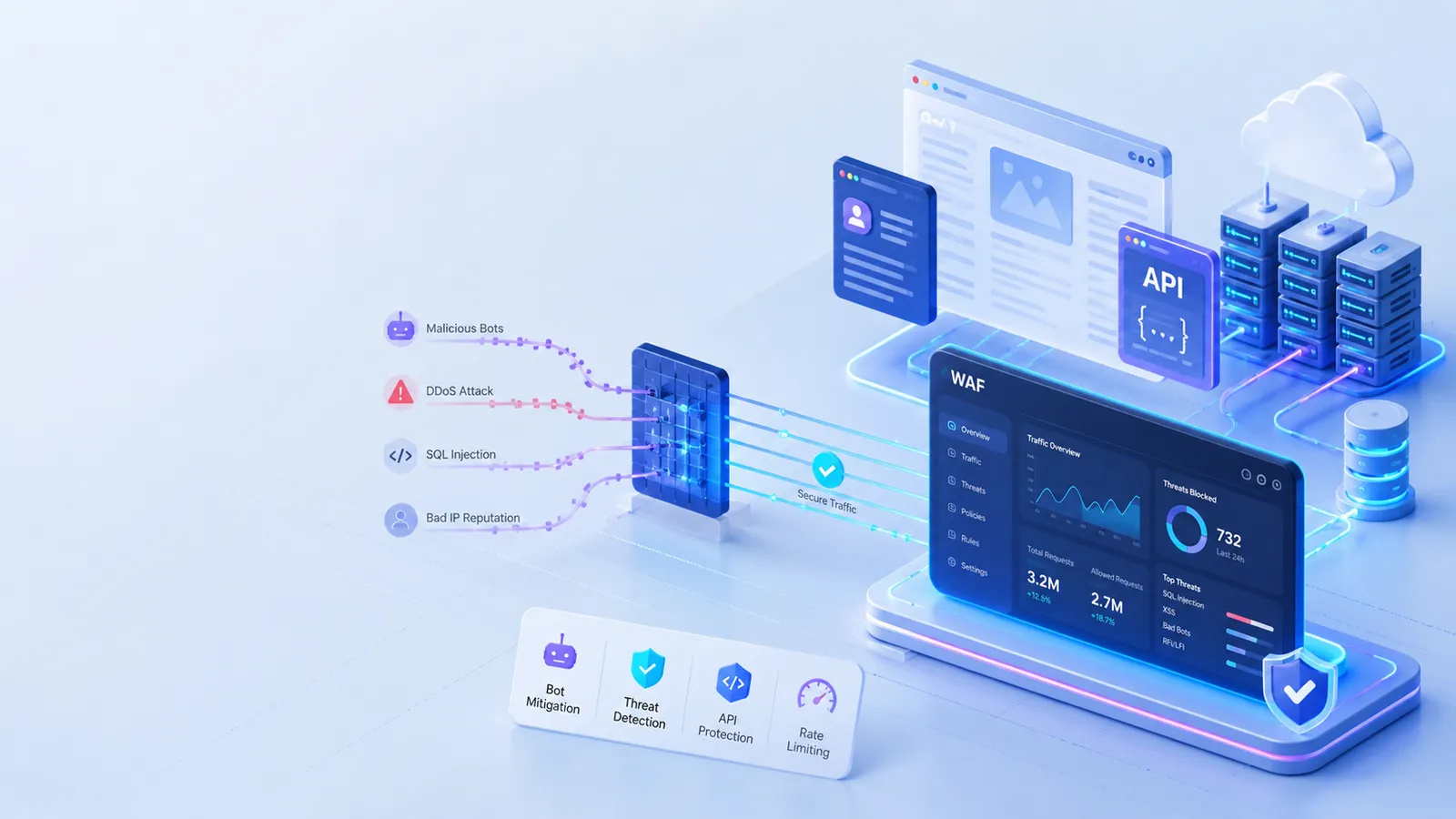
AI Agent Security: How a Security CDN Defends Against API Abuse and DDoS
Published on 2026-08-24|By ByteShield Team
Key takeaways
- AI agents have no fixed execution path. Their traffic changes with application responses, blurring the line between attack and legitimate traffic.
- Real risk begins when an agent gains the ability to act: one over-privileged token can be manipulated into operations far beyond its original task.
- A handful of requests can exhaust backend resources. Sustained calls to expensive APIs are application-layer DDoS by another name.
- A WAF still matters, but it cannot judge agent safety on its own. Layered defense built around a Security CDN is required.
- Security must move from blocking bots to governing machine identities: identify, authorize, limit, analyze, and monitor continuously.
Until recently, booking a hotel, making a purchase, or checking an account meant opening a website or app, logging in, and working through each step in person. As AI agents spread, that interaction model is changing fast.
Now a user may simply say: "Find me the best flight to Tokyo next week, confirm the price, and book it." The AI agent then searches on its own, compares prices, logs in to services, calls booking APIs, reads payment details, and may complete the transaction outright.
From the user's perspective this is efficient automation. From an application security perspective, a single task can trigger dozens of API calls, data exchange across multiple systems, and a machine identity with real operating permissions.
When large numbers of AI agents, AI crawlers, and automation tools hit enterprise websites and APIs at the same time, the problem goes beyond data access and authorization. API abuse, backend resource exhaustion, application-layer DDoS, and malicious bots all follow. Traditional DDoS protection or a standalone WAF struggles with traffic that carries a legitimate identity yet behaves abnormally.
The security question of the future is not "is this machine traffic?" but "who is this machine identity, what can it do, and does its current behavior make sense?"
How AI agents change application traffic
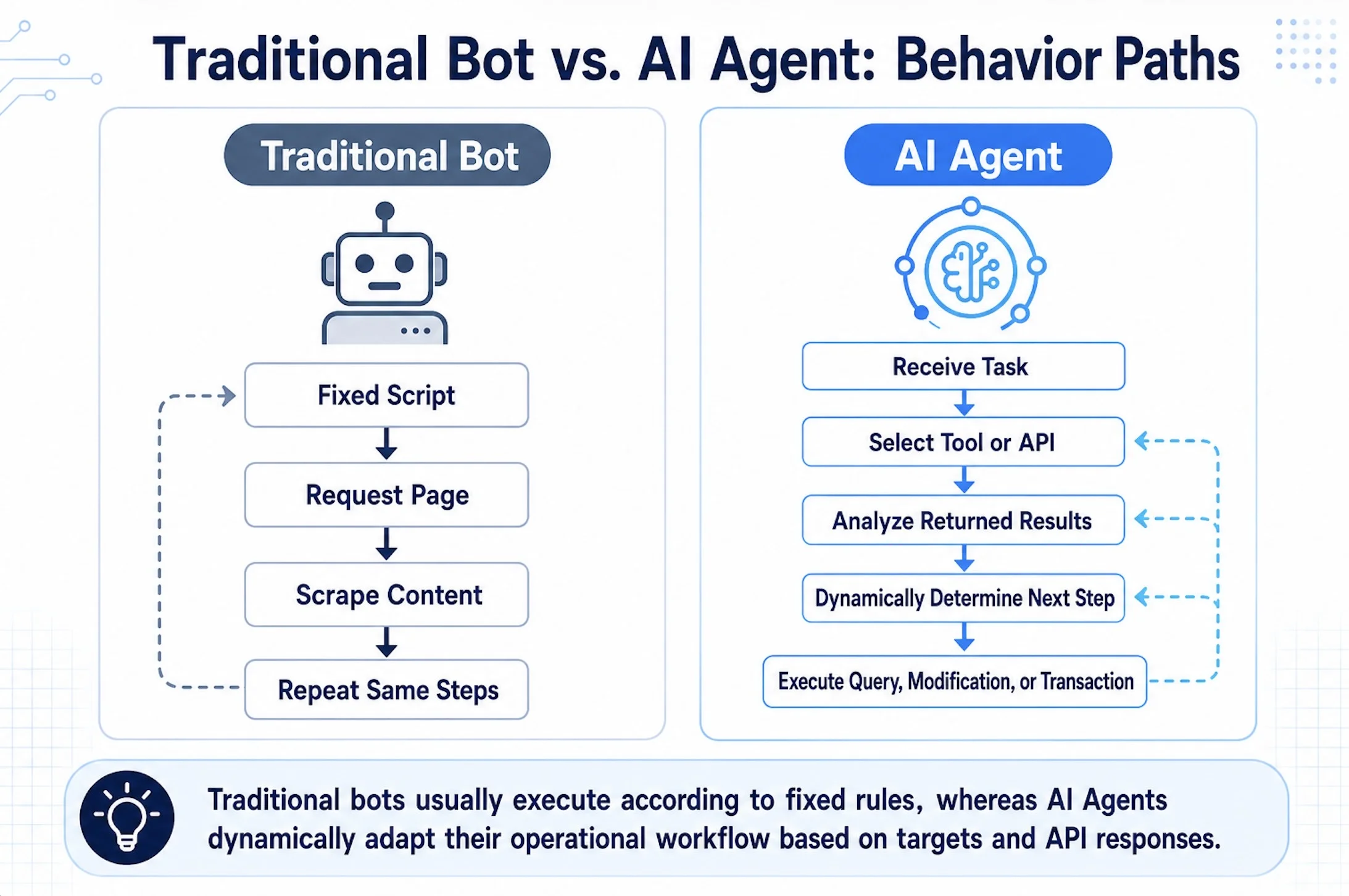
Traditional bots and AI agents differ fundamentally in their traffic patterns.
Traditional bots follow relatively fixed paths. A content scraper reads pages in a set order; a credential-stuffing tool hammers the login endpoint with username and password pairs. The request order, rate, and signatures repeat, so IP reputation, User-Agent, device fingerprinting, and request frequency identify them easily.
AI agents have no fixed path. They interpret the task first, then choose tools. If an API returns incomplete data, the agent adjusts parameters and retries. If one service fails, it switches to another API or asks another model for help.
In other words, AI agent traffic changes with the application's real-time responses. Signature- and rule-based DDoS protection struggles to classify it because the boundary between attack traffic and normal traffic has effectively dissolved.
A legitimate AI agent may issue automated requests on behalf of a real user. An internal enterprise agent may call dozens of APIs in a short window. Malicious automation can also imitate the request format and pacing of a legitimate agent.
A security system that judges by IP, User-Agent, or a single request will run into two problems at once: blocking legitimate automation, or letting malicious traffic disguised as a normal agent reach the backend.
Companies therefore need to look beyond the request itself to the machine identity behind it, its API scope, session context, historical behavior, and how a sequence of operations fits together. That is exactly the value a new generation of Security CDN delivers by combining edge protection with behavior analysis.
Real risk starts when the agent can act
Large language models handle understanding. APIs give the agent the ability to act.
With the right APIs and credentials, an agent can read customer data, check inventory, create orders, send messages, modify accounts, and even issue refunds or payments. The more systems an agent can reach, the wider the blast radius when it errs or is manipulated.
Consider a company that only wants its customer service agent to look up order status. For development convenience, it issues a token that can read, modify, and refund orders. When the agent is led astray by malicious content or its goal is hijacked, an attacker can use that legitimate credential to perform operations far outside the original task.
These attacks carry none of the classic signatures such as SQL injection or XSS. They slip past a traditional WAF and represent a more cunning application-layer DDoS variant for the AI era, which is why a Security CDN with behavior analysis matters.
From the WAF's point of view, the request may even be perfectly well-formed, authenticated, and schema-compliant.
The key question is not whether the request is valid, but whether the identity issuing it should be performing that operation. Agent access cannot be decided solely by "holds a valid token." Companies need separate machine identities per agent, short-lived and revocable credentials, and clean separation of read, modify, delete, and approve permissions. Operations involving payments, refunds, account privilege changes, or production changes should require additional verification or human confirmation.
A few requests can exhaust application-layer resources
When people think of automated traffic attacks, they picture floods of packets or a surge of HTTP requests. But the resource risk AI agents introduce does not need traditional DDoS scale.
Imagine an agent that keeps calling report generation, video transcoding, large database queries, or AI model inference. Even at a few requests per second, each call may consume substantial CPU, memory, database connections, and third-party quota.
Some APIs also trigger SMS, email, identity verification, or paid AI services. The agent then does more than degrade performance: it drives up cloud and third-party costs directly. This sustained consumption of specific APIs is, at its core, an application-layer DDoS. Network-layer DDoS protection cannot see it. Countering it requires a Security CDN with integrated rate limiting and resource controls.
The OWASP API Security Top 10 classifies this risk as Unrestricted Resource Consumption. Protection cannot stop at how many requests per second the whole site receives. It has to account for the real compute cost of each API.
Fetching a static image and generating a multi-year report are both a single HTTP request, yet their backend load could not be more different. Rate limiting therefore has to evolve from simple per-IP throttling into multi-dimensional control. Companies can set quotas by agent identity, API key, user, tenant, endpoint, and operation cost, and cap concurrent connections, query scope, file size, and maximum execution time.
| API type | Resources consumed | Suitable control |
|---|---|---|
| General data queries | Database connections, bandwidth | Rate limit per token or user |
| Report and file generation | CPU, memory, storage | Cap concurrency and maximum execution time |
| AI model inference | GPU, tokens, paid quota | Set usage quotas and cost ceilings |
| Login and verification | Auth systems, SMS services | Multi-dimensional limits by device, account, and IP |
| Payments and refunds | Payment flows, business risk | Strengthen authorization and add secondary confirmation |
Controls like these keep a misconfigured or abused agent from draining backend resources in minutes.
A WAF still matters, but it cannot judge agent safety alone
A WAF effectively blocks common web attacks, malicious payloads, protocol anomalies, and known exploits. But many AI agent risks are unreasonable behavior in a legitimate format.
A request may use a normal HTTPS connection, carry a valid token, and match the API schema perfectly, yet repeatedly query sensitive data in a short window or perform operations unrelated to the original task.
That is why AI agent security cannot rely on a single product. It needs layered defense with a Security CDN at the core:
- WAF identifies attack signatures in requests
- API Protection restricts endpoints, methods, schemas, and data access scope
- Bot Management distinguishes search engines, approved crawlers, enterprise agents, and malicious automation
- Rate Limiting controls the resource consumption that machine speed creates
- Identity and authorization decide what each agent can actually do
- Behavior analysis connects these signals to judge whether a seemingly legitimate agent is drifting from its normal pattern
A single request looking normal does not mean the whole operation sequence is reasonable.
Suppose a customer service agent normally calls only the order lookup API, then one day starts hitting the refund endpoint heavily from a new network source. Each request on its own may be well-formed and authenticated. Combine the agent's history, where the token is being used, the API paths, and the operation frequency, and the anomaly is obvious.
Build the first layer of control before traffic reaches the origin
Most external agents, AI crawlers, and automation tools reach enterprise websites and APIs over the public internet. That makes the network edge the natural place to observe and control automated traffic.
With a Security CDN, companies can run protocol checks, WAF filtering, bot classification, IP reputation analysis, access control, and rate limiting before traffic reaches the API gateway, application servers, and databases.
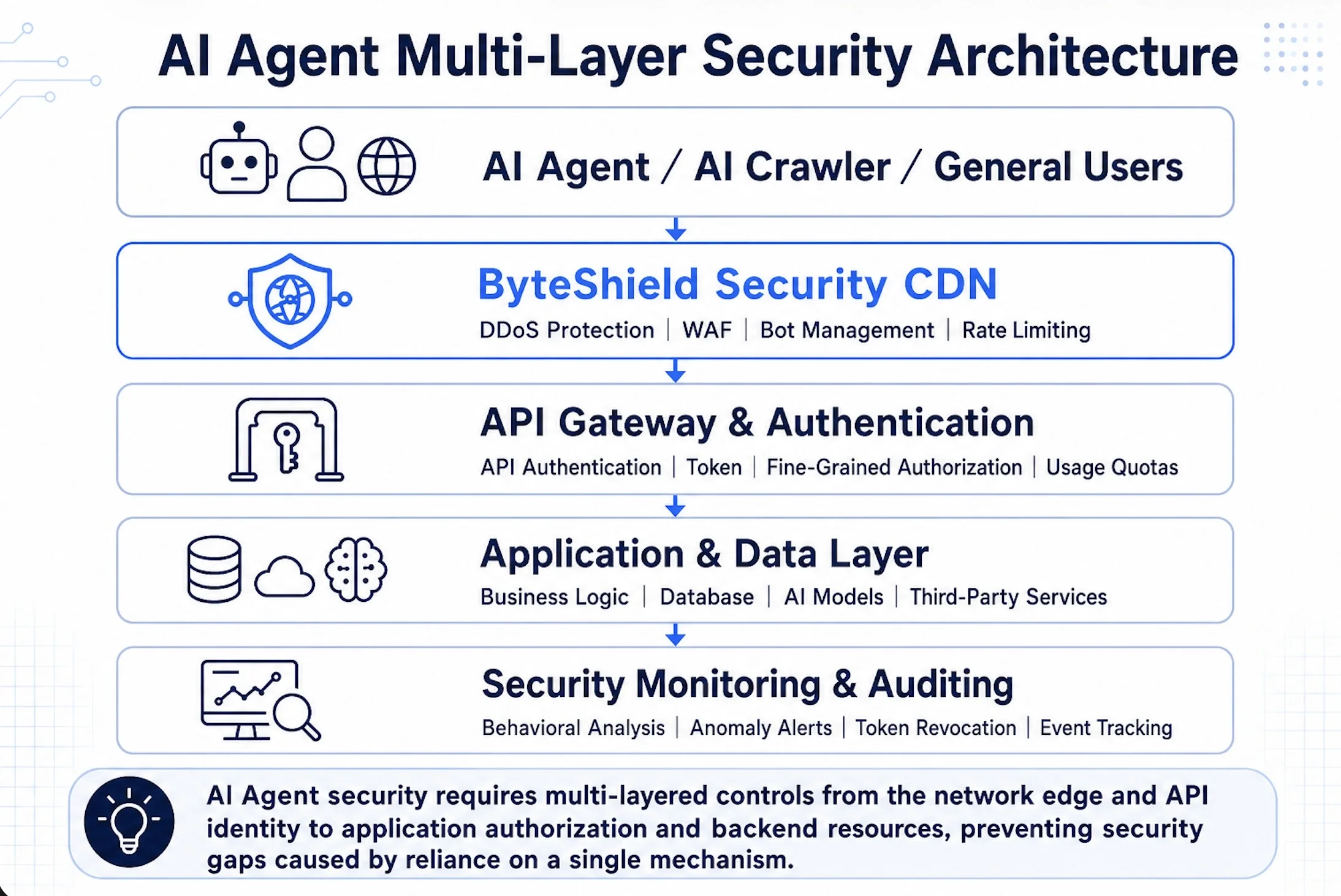
This design keeps unnecessary requests out of the backend, but edge security does not replace internal identity and authorization management. A complete architecture still connects edge traffic data with the API gateway, IAM, application logs, and SIEM.
From blocking bots to governing machine identities
AI agents are blurring the lines between human users, applications, crawlers, and bots.
Companies can no longer treat machine traffic as allow-all or block-all. Legitimate enterprise agents, search engines, monitoring services, and partner APIs may all be essential to the business. At the same time, malicious programs will imitate that legitimate traffic to slip past existing defenses.
A security process fit for the AI agent era starts by identifying the machine identity, then decides whether to allow, throttle, challenge, or block based on its authorized scope, request rate, operational context, and historical behavior.
Identify → Authorize → Limit resources → Analyze behavior → Monitor continuously → Block when necessary
The API becomes the most critical control point. It is not just the interface where systems exchange data. It is the doorway through which an AI agent moves from understanding an instruction to executing an action.
The sooner a company builds API inventory, agent identity management, least privilege, resource quotas, and cross-system auditing, the better it can adopt AI automation without losing control of application security, data access, and backend cost.
Meeting the next generation of automated traffic with a Security CDN
When AI agents can operate websites and APIs at machine speed, application security has to move from point defenses to defense in depth spanning network, identity, API, application, and behavior analysis.
ByteShield Security CDN integrates DDoS protection, WAF, Bot Management, Rate Limiting, and access control to identify and filter abnormal traffic before it reaches the origin, reducing the impact of automated abuse on APIs, application servers, and backend resources.
FAQ
How is AI agent traffic different from traditional bot traffic?
Traditional bots follow fixed execution paths with repetitive request order, rate, and signatures, so IP reputation, User-Agent, and request frequency can identify them. An AI agent interprets a task first, then picks tools, adjusting parameters, retrying, or switching to other APIs based on responses. Its traffic pattern changes with the application's replies, which rule-based protection struggles to recognize.
Why can a small number of requests still cause application-layer DDoS?
An AI agent may repeatedly call expensive APIs such as report generation, video transcoding, large database queries, or model inference. Even at low requests per second, each call consumes significant CPU, memory, database connections, and third-party quota. This is effectively an application-layer resource exhaustion attack against specific APIs.
Can a WAF alone protect against AI agent risks?
No. A WAF identifies attack signatures in requests, but many AI agent risks are unreasonable behavior in a legitimate format: requests that pass authentication and match the API schema yet perform actions outside the original task. Protection needs API Protection, Bot Management, Rate Limiting, identity and authorization, and behavior analysis working together, with a Security CDN as the core.
If your company is planning to adopt AI agents, or is already dealing with AI crawlers, API abuse, and malicious automated traffic, take a look at ByteShield Security CDN, or contact the ByteShield team to assess the right protection for your application architecture.